
NCRA Ethics First Campaign
WCRA encourages all reporters and freelance court reporting firms to abide by and participate in the NCRA Ethics First Campaign. The documents below can be downloaded and used for distribution if you wish.
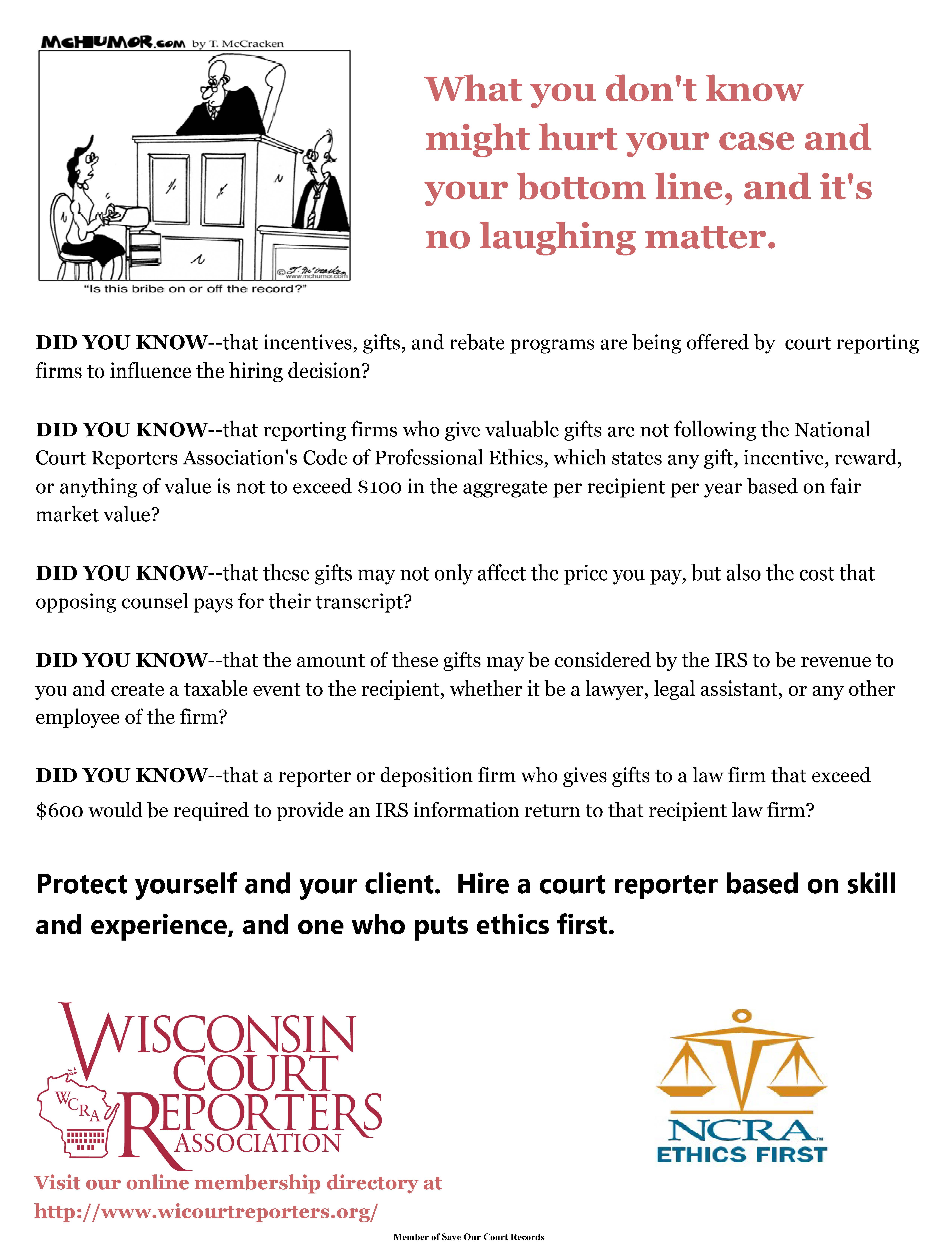
Ethics First with Cartoon--Wisconsin.pdf
DICE--Wisconsin.pdf
Per the WCRA Bylaws, Article I, Section 3(h), WCRA has adopted the National Court Reporters Association (NCRA) Code of Professional Ethics.
"Article I, Section 3(h) To adopt a Code of Ethics consistent with that of the
National Court Reporters Association (hereinafter NCRA) and
professional standards as guidelines for members."
NCRA has a formal complaint procedure that can be viewed at:
NCRA COPE Complaint Procedure
Several Advisory Opinions have also been published. These opinions can be viewed at:
COPE Advisory Opinions
WCRA Code of Professional Ethics
On April 24th, 2009, the WCRA Code of Ethics was adopted by the Wisconsin Court Reporters Association Board of Directors, based on the National Court Reporters Association Code of Professional Ethics.
WCRA’s Code of Professional Ethics outlines what the public, the bench and the Bar have a right to expect from a verbatim reporter.
These guidelines have been established toward which every reporter should strive. Reporters are urged to comply with these guidelines, which do not exhaust the moral and ethical considerations with which the reporter should conform, but provide the framework for the practice of reporting. Not every situation a reporter may encounter can be foreseen, but fundamental ethical principles are always present.
A Wisconsin Court Reporter Shall:
- Be fair and impartial toward each participant in all aspects of reported proceedings, and always offer to provide comparable services to all parties in a proceeding.
- Be alert to situations that are conflicts of interest or that may give the appearance of a conflict of interest. If a conflict or a potential conflict arises, the Member shall disclose that conflict or potential conflict.
- Guard against not only the fact but the appearance of impropriety.
- Preserve the confidentiality and ensure the security of information, oral or written, entrusted to the Member by any of the parties in a proceeding.
- Be truthful and accurate when making public statements or when advertising the Member's qualifications or the services provided.
- Refrain, as an official reporter, from freelance reporting activities that interfere with official duties and obligations.
- Determine fees independently, except when established by statute or court order, entering into no unlawful agreements with other reporters on the fees to any user.
- Refrain from giving, directly or indirectly, any gift, incentive, reward or anything of value to attorneys, clients, witnesses, insurance companies or any other persons or entities associated with the litigation, or to the representatives or agents of any of the foregoing, except for (1) items that do not exceed $100 in the aggregate per recipient each year, or, (2) pro bono services as defined by the NCRA Guidelines for Professional Practice or by applicable state and local laws, rules and regulations.
- Maintain the integrity of the reporting profession.
- Abide by the WCRA Constitution & Bylaws.
NCRA Code of Professional Ethics
Preamble
The mandatory Code of Professional Ethics defines the ethical relationship the public, the bench, and the bar have a right to expect from a Member. The Code sets out the conduct of the Member when dealing with the user of reporting services and acquaints the user, as well as the Member, with guidelines established for professional behavior. The Guidelines for Professional Practice, on the other hand, are goals which every Member should strive to attain and maintain. Members are urged to comply with the Guidelines and must adhere to local, state and federal rules and statutes. It should be noted that these guidelines do not exhaust the moral and ethical considerations with which the Member should conform, but provide the framework for the practice of reporting. Not every situation a Member may encounter can be foreseen, but a Member should always adhere to fundamental ethical principles. By complying with the Code of Professional Ethics and Guidelines for Professional Practice, Members maintain their profession at the highest level.
Code of Professional Ethics
A Member Shall:
- Be fair and impartial toward each participant in all aspects of reported proceedings, and always offer to provide comparable services to all parties in a proceeding.
- Be alert to situations that are conflicts of interest or that may give the appearance of a conflict of interest. If a conflict or a potential conflict arises, the Member shall disclose that conflict or potential conflict.
- Guard against not only the fact but the appearance of impropriety.
- Preserve the confidentiality and ensure the security of information, oral or written, entrusted to the Member by any of the parties in a proceeding.
- Be truthful and accurate when making public statements or when advertising the Member's qualifications or the services provided.
- Refrain, as an official reporter, from freelance reporting activities that interfere with official duties and obligations.
- Determine fees independently, except when established by statute or court order, entering into no unlawful agreements with other reporters on the fees to any user.
- Refrain from giving, directly or indirectly, any gift, incentive, reward or anything of value to attorneys, clients, witnesses, insurance companies or any other persons or entities associated with the litigation, or to the representatives or agents of any of the foregoing, except for (1) items that do not exceed $100 in the aggregate per recipient each year, or, (2) pro bono services as defined by the NCRA Guidelines for Professional Practice or by applicable state and local laws, rules and regulations.
- Maintain the integrity of the reporting profession.
- Abide by the NCRA Constitution & Bylaws.
CLVS Code Of Professional Ethics
Preamble
The mandatory Code of Professional Ethics for Certified Legal Video Services (CLVS) defines the ethical relationship the public, the bench, and the bar have a right to expect from a CLVS Member. The Code sets out the conduct of the CLVS Member when dealing with the user of video services and acquaints the user, as well as the Member, with guidelines established for professional behavior. By complying with the CLVS Code of Professional Ethics, CLVS Members maintain their profession at the highest level.
A CLVS Member must also adhere to the voluntary Principles for Professional Practice when providing legal video services as well as all local, state and federal rules and statutes.
Code of Professional Ethics
A CLVS Member Shall:
- Render services to all parties in a competent manner. A CLVS shall maintain the integrity of the legal video profession.
- Perform all tasks in a professional manner, observing all laws, rules and orders of the court relating to the proceedings.
- Refrain from performing any service under terms or conditions that will compromise, in any way, his or her impartiality or the exercise of good judgment. A CLVS shall not adversely affect the fair and impartial portrayal of the proceeding.
- Refrain from doing anything that affects the impartiality of the CLVS.
- Absent the consent of the parties concerned or a court order, a CLVS shall not reveal confidential information entrusted in or provided to such CLVS by any of the parties.
- Be truthful and accurate when making public statements or when advertising the CLVS' qualifications or the services provided.
- Determine fees independently, except when established by statute or court order, entering into no unlawful agreements with others on the fees to any user.
Refrain from giving, directly or indirectly, any gift, incentive, reward or anything of value to attorneys, clients, witnesses, insurance companies or any other person or entities associated with the litigation, or to the representatives or agents of any of the foregoing, except for (1) items that do not exceed $100 in the aggregate per recipient each year, or, (2) pro bono services as defined by the NCRA Guidelines for Professional Practice or by applicable state and local laws, rules and regulations.